
Cristian Specogna: A story of wine that is also part of my own
Written by Davide Gangi | Published in people, wine 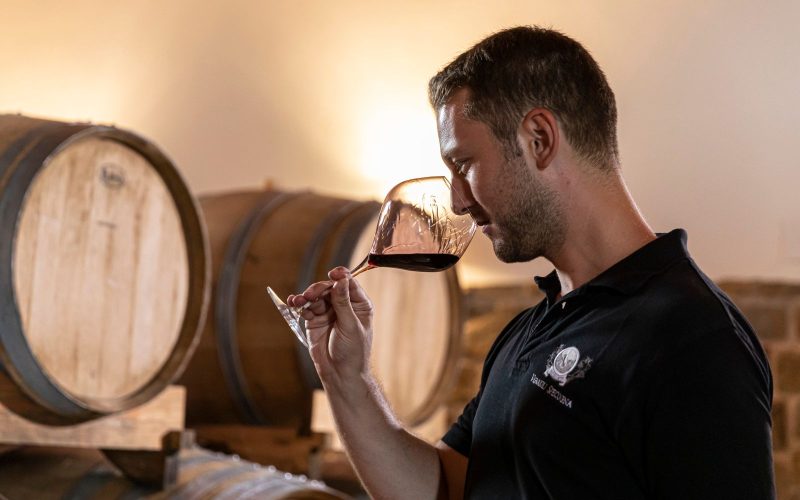
Writing about Cristian Specogna is harder for me than writing about many other winemakers I’ve met over the years because he’s part of my life as a wine enthusiast—a part that predates even Vinoway. I’ve known him for almost twenty years, and when we first met, Vinoway didn’t even exist yet; he was trying to figure out what direction his future would take within a family that had already built a remarkable legacy through the land and wine.
When I look back today, I realize that our paths have run almost parallel. I was embarking on a journey that, many years later, would become what Vinoway is today, while Cristian was trying to understand just how far he could take the work begun by his grandfather Leonardo and continued by his father Graziano. Perhaps this is also why talking about him inevitably means sharing something about myself, because over nearly twenty years I’ve come to know his winery—and above all, his wines—intimately. I’ve watched them come into being, change, and grow; I’ve tasted them harvest after harvest; and today I can speak of Specogna not through a snapshot of a single moment but through a memory that has been built up over time.
Prima dei vini però ho conosciuto gli uomini e tra questi suo padre Graziano, uomo concreto e lavoratore instancabile, uno di quelli che Cristian ama definire “senza sosta”, con quella mentalità profondamente friulana fatta di poche parole, sacrificio e lavoro. Cristian l’ha sempre rispettata anche quando da ragazzo ha dovuto trovare il coraggio di confrontarsi con essa per cercare una propria strada.
The family’s story begins in 1963, when, after spending several years as an immigrant in Switzerland, he returned to Friuli and chose the hills of Corno di Rosazzo. At first, the farm engaged in various activities, but under Graziano’s leadership, viticulture took on an increasingly important role until it became the heart of the business. Today, Cristian and his brother Michele carry on that legacy with dedication and self-sacrifice, mindful of what they have inherited but also of their responsibility to do more than simply preserve it.
Cristian felt this need to find something of his own very early on. He was just sixteen when he began spending a lot of time at the winery with his father. He observed, experimented, and above all, felt the need to learn about what was happening outside of Friuli. He traveled throughout Italy, spending time in the great wine regions of Tuscany and Piedmont; he traveled to France, to Burgundy; he tasted and listened a great deal, but most importantly, he returned home each time with a deeper understanding.
He never tried to transform his hills into something they weren’t. Rather, everything he had seen helped him better understand what had always been right before his eyes and beneath his feet. I believe this is also the source of that quest for identity that, over the years, has become central to his approach to wine, and it is no coincidence that one of his wines bears this very name, “Identità,” as if to encapsulate in a single word a journey marked by knowledge, reflection, and a return to his roots.
Before reaching the level of awareness she has today, however, she had to carve out her own space even within her own home, and there’s one incident that illustrates her relationship with her father very well. He wanted to experiment on a few rows of vines; he had a clear vision and wanted to see it through to the end, but he knew that convincing his father, Graziano, wouldn’t be easy. So he decided to do it in secret: he personally tended to those vines and carried out his experiment all the way through to vinification without saying a word.
When the wine was ready, he gathered the family together and even had his father taste it in a blind tasting. I can imagine what it must have meant for that young man to wait for his father’s judgment after taking such a risk. Graziano tasted it and finally said simply, “Starting tomorrow, it’s your turn.”
I really like this story because, in those few words, there’s a genuine generational handoff—without any fanfare or grand speeches. There’s a father who recognizes that his son is ready, and a son who didn’t ask for that trust but earned it through hard work. He probably truly became a winemaker right at that moment.
Pensare al ragazzo che conobbi allora e guardare l’uomo di oggi mi fa anche sorridere perché da ragazzo era timidissimo, chiuso e quasi intimorito dall’idea di esporsi, mentre oggi è un “vulcano”, un fiume in piena che quando comincia a parlare delle sue vigne e dei suoi vini riesce a trascinarti dentro il racconto. Ha sviluppato grandi capacità agronomiche ed enologiche ma possiede soprattutto qualcosa che non ti può insegnare nessuno, quella capacità di entrare in relazione con le persone che passa attraverso l’empatia, l’accoglienza e un modo naturale di comunicare.
When he opens the doors to his winery, after just a short while you forget you’ve stepped into a winery because you feel as if you’ve arrived at the home of someone who’s truly happy to have you there. It’s no coincidence that he loves to welcome his guests by saying, “Welcome to my paradise—for the vine and for life,” and knowing him well, I know that’s not just a phrase meant to sound impressive. Those hills really are his paradise, and when he looks at them, you can clearly see just how much a part of his life they are.
Over the course of nearly twenty years, we’ve shared countless tastings, and some wines have inevitably become part of our memories as well. Once, right at his house, I told him—with that healthy bit of teasing that’s sometimes part of our relationship—that Friuli had proven it could produce truly great white wines, while I had a few more doubts about the reds. Cristian didn’t try to convince me with words; he grabbed a bottle and had me taste Oltre. I was captivated, and some time later, he confided in me that my comment had stuck with him and spurred him to work even harder on his red wines.
Even today, this story makes us smile, but it also says something about the relationship we’ve built, because for me, friendship doesn’t mean always telling each other that everything is perfect. It means having enough respect for one another to be able to challenge each other, tease each other, and sometimes even disagree, knowing that respect remains at the core.
“Oltre” is just one part of what I’ve seen develop over the years. I’m thinking of the Sauvignon Riserva, the Duality, the Identità, and the Pinot Grigio Ramato Riserva—wines that are all different from one another, but in which I’ve gradually come to recognize a deeper understanding. I don’t want to get into technical descriptions because that’s not the point of my story. What interests me most about these wines is what they represent in Cristian’s journey—his desire to gain a deep understanding of his land while never feeling like he’s “made it,” to keep trying and searching without losing his connection to his roots.
I’ve had the privilege of tasting several vintages, which allows me to trace their evolution with a perspective that didn’t just begin today. I first encountered some of them when they were still just ideas, and I’ve rediscovered others years later with an increasingly well-defined character. It’s also through these bottles that I’ve watched Cristian grow—and with him, the entire winery.
Here, inevitably, his story intersects with that of Vinoway, because Specogna has always been featured in our guide, and through our tastings we’ve been able to observe over time something that may seem obvious today but that, many years ago, was still in its infancy. We at Cristian believed in it very early on, and I say this with pride but also with great peace of mind.
We weren’t the only ones to recognize him, and it wouldn’t make sense to tell the story this way. Since then, there have been other awards, more recognition, and colleagues who have acknowledged the value of his work. Perhaps, however, we can say that we were among the first to truly believe in him, and time—that much is certain—has proven us right.
When Vinoway decided to honor Cristian Specogna as Best Italian Winegrower of 2023, we weren’t honoring a friend—and I want to make a point of saying this because it was precisely our friendship that imposed an even greater responsibility on us. Affection belongs to the personal sphere, while recognition must be based on merit, and on that day we honored the winemaker, his journey, what we had seen in the vineyards, and above all, what we had tasted in our glasses year after year.
We never needed to confuse the two. I can love Cristian and at the same time know that he earned that award. In fact, perhaps the greatest value of that decision lies precisely in the fact that the years that followed brought other accolades and further recognition.
And yet, if I had to choose the image of Cristian that moves me the most today, I wouldn’t choose an award—or even a bottle, for that matter. I’d choose his daughter Mariasole walking with him through the vineyard.
Quando Cristian parla di lei cambia persino il modo in cui racconta le cose. Mariasole è la sua gioia immensa e lo segue tra i filari proprio come lui faceva da bambino con suo padre. Mi ha raccontato che guardandola riconosce alcuni gesti e alcune movenze di Graziano e che questa cosa gli provoca ogni volta un’emozione fortissima. Posso comprenderlo perché in quel momento davanti ai suoi occhi non c’è soltanto sua figlia ma sembra quasi ricomporsi tutta la storia della famiglia, da Leonardo a Graziano, da Graziano a Cristian e adesso da Cristian a questa bambina che comincia a conoscere quelle stesse vigne semplicemente camminando accanto al suo papà.
Then there’s a coincidence so beautiful that it doesn’t need to be laden with meaning. No girl had been born into the Specogna family for four generations, and Mariasole was born on September 6—exactly the same day that Leonardo, the company’s founder, was born. I don’t know if such coincidences really mean anything—and perhaps there’s no need to even ask—but I like to think of this invisible thread that spans the generations and connects the great-grandfather to his great-granddaughter on the same day in September and on the same hills.
That’s also why, when I think of him, I find it hard to separate the winemaker from the man. I’ve met countless winemakers in my professional life, and I’ve formed genuine friendships with some of them, but Cristian—and I hope the others won’t mind—holds a special place in my heart because I remember where we started. I remember the shy young man, I remember his father Graziano, I remember the first bottles, the tastings, the discussions, and the challenges, and I also remember myself back when Vinoway didn’t even exist yet.
Then the years went by, Cristian grew up, Specogna grew up, and Vinoway grew up—and perhaps that’s exactly what moves me the most today: realizing that, in some way, we’ve grown up together without ever planning it.
I’m sure that when I return, I’ll find a company that’s profoundly different from the one I left a few years ago; I’ll find a man who’s no longer afraid to speak his mind or talk about what he does. But when the door opens and, after a few minutes, the glasses and bottles arrive, I’ll rediscover something that, fortunately, time hasn’t managed to change. He’ll start talking; I might prod him a little more; he’ll take off like a river in flood, and suddenly it will seem as if these nearly twenty years have never passed.
Perhaps the greatest success is precisely this: being able to go very far without forgetting who you were when you started out, and Cristian, despite all the ground he’s covered, hasn’t forgotten that.
Specogna has always been part of Vinoway’s history, but Cristian is part of a story that, for me, began even earlier—and one that doesn’t need scores, tastings, or awards to be told.
Appartiene al mio percorso e, questa volta permettetemi di dirlo semplicemente per quello che sento, anche al mio cuore.
Related posts

Vinoway confirmed by Feedspot: 2nd place among the best food…
For the second consecutive year, Feedspot – one of the leading international content curation platforms – has ranked Vinoway...
Leone de Castris: A Family Rooted in the History of…
More than 360 years is hard to even imagine when it comes to wine. Times change, people change, the...

Adolfo Scuotto: the “guy” who chose wine as his language
Every region has its interpreters, and Irpinia has found a unique narrator in Adolfo Scuotto, who has chosen wine...